
The Day Google Killed Thousands of Websites Overnight
How Algorithm Updates, AI Content, and SEO Obsession Changed the Internet Forever
For thousands of website owners, the morning began with panic.
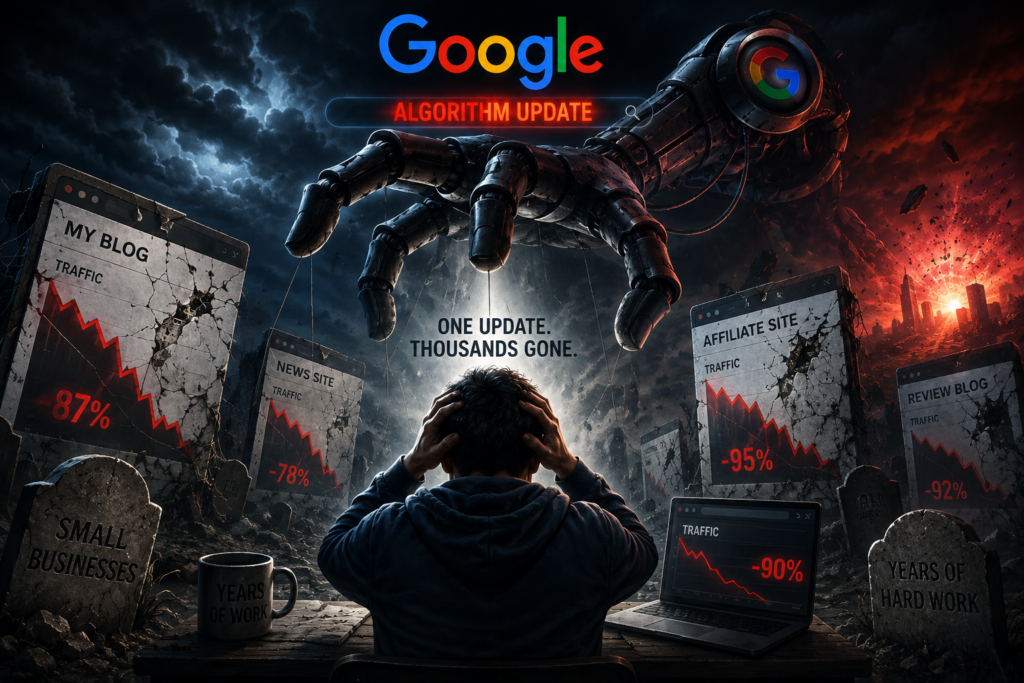
Coffee cups sat untouched beside laptops while traffic graphs collapsed in real time. Some websites lost 30% of their visitors overnight. Others lost almost everything. Businesses that depended on search rankings suddenly became invisible. Years of work disappeared between one algorithm update and the next refresh button.
Nobody received a warning email. Nobody spoke to a human representative. There was only silence — and an algorithm quietly deciding which websites deserved to survive.
The Invisible System Behind the Internet
This is the hidden reality of modern internet culture.
Most people use Google every day without thinking about the systems operating behind the screen. Search feels simple. Type a question, receive an answer. But beneath that simplicity exists one of the most powerful digital systems ever created: Google’s search algorithm.
And every time it changes, entire sections of the internet change with it.
Google originally built its algorithm to solve a problem. In the early internet, search engines were chaotic and easily manipulated. Spam websites filled results with repeated keywords and fake information. Google improved this by rewarding relevance, trust, and quality instead of pure repetition.
For a while, the system worked beautifully.
When Websites Became Businesses
Small bloggers could compete with large companies if their content was genuinely useful. Independent websites gained massive audiences simply because they answered questions better than anyone else. Search engines became the main gateway to information online.
Then money entered the equation.
Once creators realized search traffic could generate income, websites stopped being just creative spaces. They became businesses. Rankings became currency. Entire industries formed around understanding Google’s behavior. Search Engine Optimization, commonly known as SEO, transformed from a technical practice into a digital obsession.
Writers studied keywords more than ideas. Companies analyzed click-through rates like stock market charts. Content was no longer written only for readers. It was written for algorithms.
And algorithms are always changing.
The Rise of AI Content and Google’s Response
Google now releases thousands of small adjustments every year along with major “Core Updates” that can completely reshape search rankings. Some updates target spam. Others focus on low-quality content, fake backlinks, or websites designed purely to manipulate traffic.
But recent updates introduced a deeper shift.
Google started fighting something much larger than spam websites: artificial content.
As AI writing tools exploded across the internet, millions of articles began appearing almost instantly. Businesses published content at industrial speed. Some websites generated hundreds of blogs every week without genuine expertise or originality. The internet became flooded with technically correct but emotionally empty writing.
Google responded aggressively.
Updates like the Helpful Content Update focused heavily on rewarding “people-first content.” Websites built only to rank started losing visibility. Thin AI-generated articles collapsed in search results. Entire businesses built around mass-produced SEO content suddenly faced disaster.
That is why so many websites disappeared overnight.
The Creators Who Were Caught in the Collapse
However, the issue is more nuanced than just “good content versus bad content.”
Many genuine creators were affected too.
Some independent bloggers who spent years building audiences also saw massive traffic drops. Smaller websites struggled while giant brands continued dominating search visibility. Forums like Reddit began outranking traditional blogs. Large media companies gained stronger positions while personal websites became harder to discover.
For many creators, the internet stopped feeling fair.
The emotional impact of these updates is rarely discussed outside SEO communities. Behind every traffic graph is usually a human being. Someone paying bills through ad revenue. Someone who spent years writing articles after work. Someone who believed building a website could create freedom.
Then one update changes everything.
Why the Internet Suddenly Feels Artificial
This invisible pressure has transformed how modern creators behave online. Many writers no longer focus entirely on creativity because survival depends on remaining visible to algorithms. Headlines become optimized. Paragraphs become shorter. Content structures become repetitive because repeating successful formulas feels safer than experimenting.
As a result, much of the modern internet now sounds strangely similar.
Ironically, the system designed to organize information also shaped how information itself is written.
And artificial intelligence accelerated that transformation.
Today, readers are surrounded by content that feels polished but lifeless. Articles answer questions efficiently yet leave no emotional impression. The internet contains more information than ever before while somehow feeling less personal at the same time.
The Return of Human Originality
Yet something interesting is happening now.
Audiences are slowly becoming better at detecting artificiality. People recognize generic AI phrasing. They notice recycled advice and emotionless writing. Authentic voices stand out precisely because they are becoming rare.
This may become the next major shift of the internet.
For years, creators tried to please algorithms first and humans second. But in a world where machines can generate endless optimized content instantly, technical perfection alone no longer feels valuable.
Human perspective does.
Conclusion: What Google’s Updates Really Revealed
Google’s updates did not simply kill websites overnight.
They exposed a larger truth about the modern internet: visibility can be automated, optimization can be copied, and algorithms can be studied — but genuine human originality is still difficult to manufacture.
And that may be the only thing machines still cannot fully replace.